Maybe It’s Not Imposter Syndrome. Maybe It’s Fear.

We often label our hesitation as imposter syndrome.
We tell ourselves:
“I’m not ready.”
“I need more experience.”
“I should wait.”
“Someone else is better.”
“What if I get it wrong?”
“I’m not leadership material.”
At first glance, these thoughts seem like evidence that we don't belong. They sound like a lack of confidence, competence, or qualifications. But what if they're actually masking something deeper?
The Hidden Truth Behind Self-Doubt
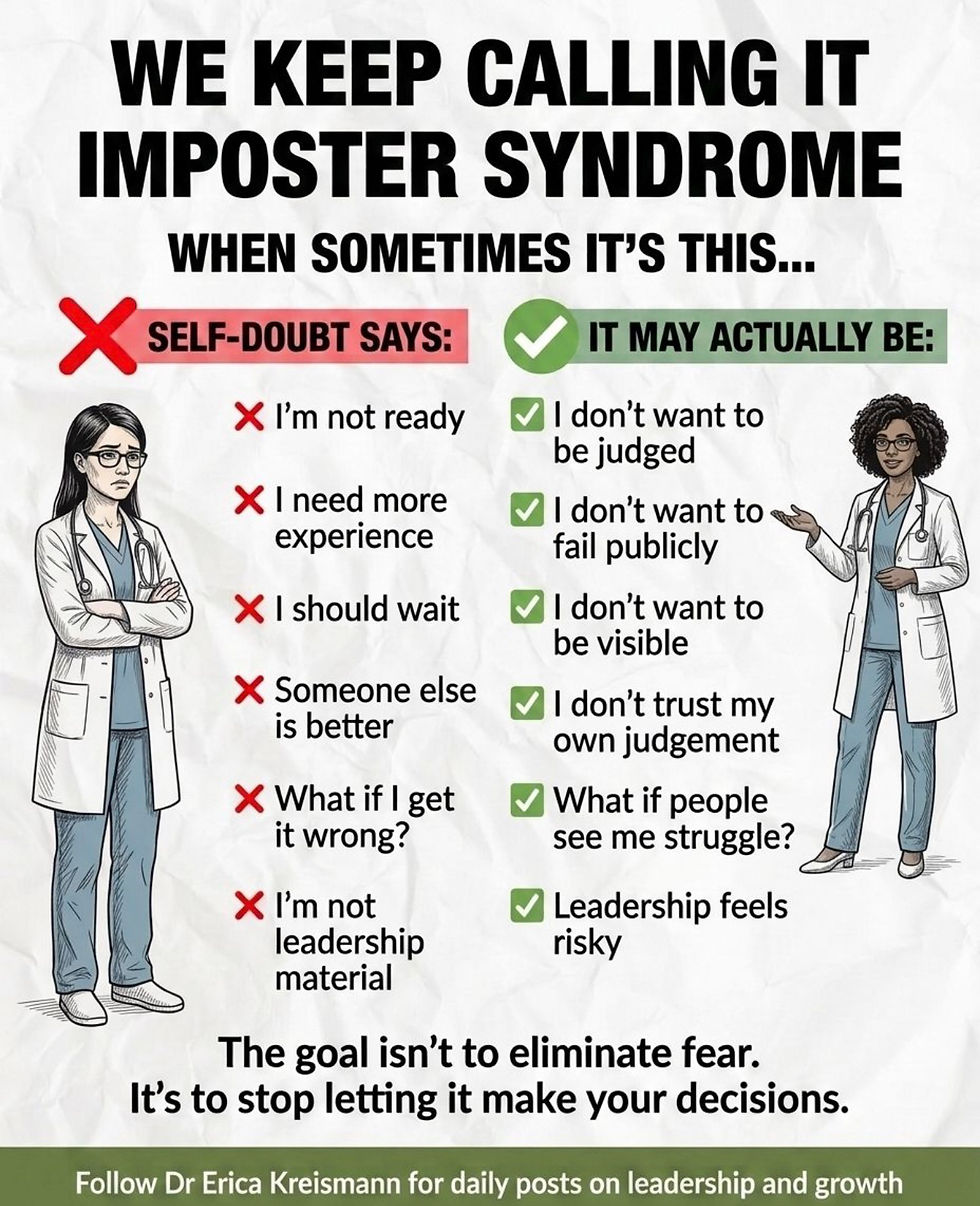
The image challenges a common assumption. What we call imposter syndrome may sometimes be something else entirely:
Fear of being judged.
Fear of failing in public.
Fear of being visible.
Fear of trusting our own judgment.
Fear of letting others see us struggle.
Fear of taking on the risks that leadership requires.
When we reframe these thoughts, something powerful happens. Instead of questioning our capabilities, we begin to recognize the real obstacle: fear.
And fear is a very different problem to solve.
Why This Distinction Matters
If you believe you're an imposter, you'll spend your energy trying to prove your worth. You'll chase more certifications, more preparation, and more validation.
But if the real issue is fear, additional preparation may never feel like enough.
The challenge isn't gaining more competence. The challenge is finding the courage to act despite uncertainty.
Many talented professionals remain stuck not because they lack ability, but because they are waiting for fear to disappear before they move forward.
Unfortunately, that day rarely comes.
Leadership Begins Before You Feel Ready
Every leader faces moments of uncertainty.
Every expert was once a beginner.
Every successful professional has experienced situations where they didn't have all the answers.
Leadership is not the absence of doubt. It's the willingness to make decisions, take responsibility, and remain visible even when outcomes are uncertain.
The people we admire most are often not the ones with the highest confidence. They are the ones who learned how to move forward despite their fears.
Stop Letting Fear Make Your Decisions
The goal isn't to eliminate fear.
Fear is part of growth. It appears whenever we enter unfamiliar territory, take on greater responsibility, or pursue ambitious goals.
The real goal is to stop allowing fear to make decisions on our behalf.
The next time you catch yourself saying, "I'm not ready," pause and ask:
Is this truly a lack of capability, or is it a fear of being seen, judged, or challenged?
The answer may change everything.
Because growth doesn't begin when fear disappears.
Growth begins when courage becomes louder than fear.


Comments