Changing the Conversation in Your Head

We all have an inner voice. Sometimes it encourages us, motivates us, and reminds us of our strengths. Other times, it can be our harshest critic.
"I’m not good at this."
"I always make mistakes."
"I can’t do this."
Sound familiar?
Negative thoughts are a normal part of being human, but when they become our default way of thinking, they can impact our confidence, relationships, and overall mental health. The good news is that we don't have to believe every thought we think.
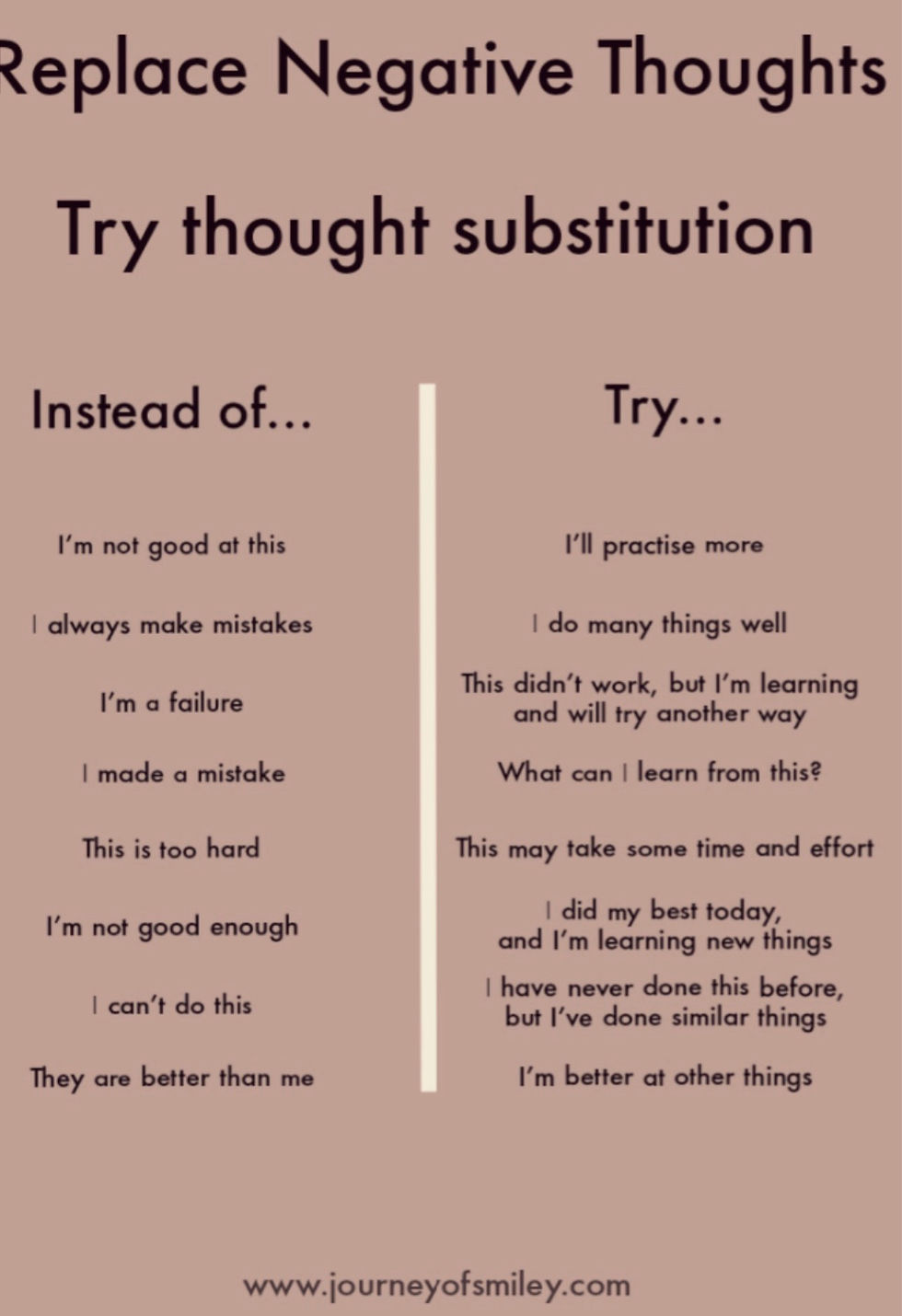
One powerful strategy is called thought substitution—the practice of replacing self-defeating thoughts with more balanced, realistic, and compassionate ones.
For example:
Instead of saying, “I’m not good at this,” try, “I’ll get better with practice.”
Instead of, “I’m a failure,” try, “This didn’t work, but I’m learning and can try another way.”
Instead of, “I’m not good enough,” try, “I did my best today, and I’m still growing.”
Notice that these replacement thoughts aren't blind positivity. They aren't pretending challenges don't exist. Rather, they acknowledge reality while creating room for growth.
Our brains are naturally wired to focus on mistakes, threats, and shortcomings. This survival mechanism may have helped our ancestors stay safe, but it can leave us stuck in cycles of self-criticism. Over time, repeatedly challenging negative thoughts can help create healthier thinking patterns and improve emotional resilience.
The next time you catch yourself engaging in negative self-talk, pause and ask:
Is this thought completely true?
What evidence supports or challenges it?
What would I say to a friend experiencing the same situation?
Is there a kinder, more balanced perspective?
Small shifts in language can create powerful shifts in mindset.
"I always mess up" becomes "Sometimes I make mistakes, but mistakes help me learn."
"They are better than me" becomes "We all have different strengths and challenges."
"This is too hard" becomes "This may take time and effort, and that's okay."
Remember, the goal isn't to eliminate negative thoughts altogether. The goal is to recognize them, question them, and replace them with thoughts that are more helpful and realistic.
At ROC Wellness Collective, we believe healing often begins with the way we speak to ourselves. Self-compassion isn't weakness—it's a skill. And like any skill, it gets stronger with practice.
The conversation happening in your mind matters. Make it one that helps you grow.


Comments